Cleveland has a long history when it comes to the Air Races. In 1929 Cleveland became the site of the National Air Races. The Cleveland Airport had opened in 1925 and with landing lights and a radio-equipped tower, it was the perfect place to hold the National Air Races.
Mystery! I have looked through Cleveland papers trying to find the event that these 1928 pictures are from- no luck. Sooo, if anyone out there has time and wants to search old Cleveland papers, let me know. I have a great website for you to use.
Cleveland to Detroit- Ford Tri-Motor Ford Hangar in the background Ford Tri-Motors carried a pilot, co-pilot, and 9 passengers. Every Tri-Motor had a bathroom!
John Stroh with Thompson Aeronautical Corp plane
Peter Stroh Jr., John’s step-brother
Here’s a link to actual footage of the 1929 Air Races:
I passed our local fruit farm and couldn’t help but notice the sign. Red Havens!! There’s nothing like a Red Haven plucked right from the tree, sliced with a pocket knife, and consumed on the spot. Every year, when the peaches “came in” our family would drive to Port Clinton to get bushels of Red Havens. My mother’s uncle (Charles “Uncle Charlie” Schuster) worked a peach orchard on Catawba Island. Mom and Grandma (Elizabeth Schuster Finken Nehls) would get together and can peaches. A lot of work and very time consuming… sterilizing jars, peeling and slicing peaches, making syrup, and finally, boiling them in the canner for 20 minutes. By the time the day was over the kitchen table was covered with quart jars of peaches. At night as they cooled , the lids would make a snapping sound. The next day we would haul the jars to the basement to be stored on the shelf till winter set in.
Canning the peaches was only the beginning… usually followed by making pickles, and canning tomatoes. I thought I’d share a few of our family recipes. If anyone is brave enough to try one of these, let me know how they come out. !
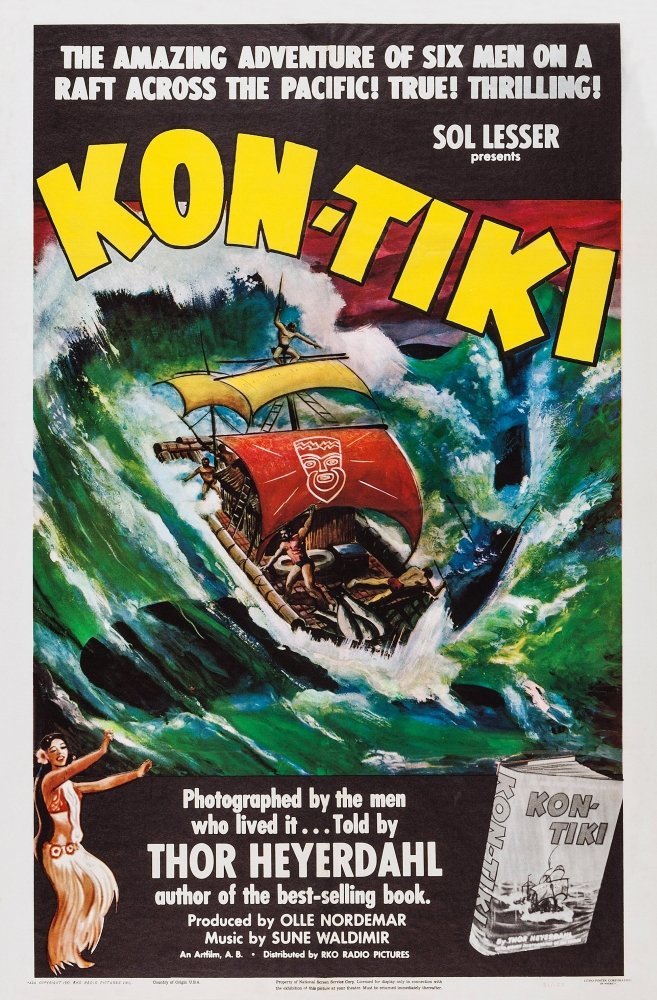
I know you’re thinking, “What does Thor Heyerdahl have to do with genealogy?” On August 7, 1947 the Kon-tiki, a balsa wood raft, completed an ocean voyage of 4,300 miles from Peru to Raroia, near Tahiti. Thor Heyerdahl, a Norwegian anthropologist, wanted to prove that prehistoric South Americans could have colonized the Polynesian Islands by drifting on ocean currents.
Heyerdahl had a crew of 5 on the 45 foot long raft. They set sail from Peru on April 28, 1947 and drifted for 101 days before washing up on Rarioa, thus proving his theory. Anthropologists and historians of the day continued to discredit his belief, in spite of his successful journey. The public, however, was entranced with his feat. His book, Kon-tiki became an international bestseller and was translated into 65 languages. His documentary of the same name, won an Academy Award in 1951.
I subscribe to “This Day in History” . When I saw this article in my email- it reminded me of Mom’s Kon-tiki story:
The Cleveland Indians played their first game at Cleveland Municipal Stadium 87 years ago today. On July 31, 1932 the Indians played the Philadelphia Athletics. The Indians would split their home schedule between League Park and Municipal Stadium until 1947. According to
Walt Disney’s Westward Ho the Wagons! by Charles Coombs
I loved that book! I don’t remember reading it, but I remember the pictures. I was fascinated by all those people riding in wagons pulled by horses. Long dresses, bonnets, kids running next to the wagon, bearded men, and … my favorite picture -Chimney Rock! Last year we had the chance to visit Chimney Rock- it was thrilling to see it in “real life”. This year I’m sure the Badlands and the Black Hills will be just as exciting.
I may find the old west fascinating, but Dad had a lifelong passion for it. Here’s his list of favorites:
Authors: Joseph Altsheler, Zane Grey, Louis L’Mour, and Tabor Evans- author of the Longarm series.
Favorite movie: The Wild Bunch
Favorite actor: John Wayne
I’m sure there’s a lot more from the 30’s, 40’s, and 50’s that were before my time, but you get the idea.
Dad, along with his mother and younger brother, immigrated to the US from Jarek, Yugoslavia, in 1907. His father, Peter, was already in St. Louis, MO- so they were tagged for St. Louis and put on a train. He celebrated his 8th birthday in the United States a week after entering through Ellis Island. Dad wrote about those early years in St. Louis:
He gives us a sense of what his childhood was like. I was very interested in the part about his mother, Annamarie Lottbrein Stroh. I always thought she was a “floor lady” at the laundry, like a manager. But he says that she worked in the fur department. St. Louis was the “Gateway to the West”- I’m sure there were many pelts being shipped from the west to St. Louis. I wish I knew more of what cleaning and dyeing furs meant back in 1910. What was her job?
Dad also got to see Buffalo Bill in person! I always thought he must have seen his Wild West Show in St. Louis. That certainly is possible, but also according to http://buffalobill.org/visit.html he visited Cleveland in 1912, 1914, and 1916. I keep looking in old Cleveland newspapers for a mention of it- but so far, no luck. If I find out more I’ll post it.
I couldn’t resist using Jaws birthday as a reason to share our own version of Jaws. I admit this “snapshot” will be “short” on the story side.
I’ve been fascinated by these photos ever since I scanned them a few years ago. What is it? Where is it? I know we have fishermen in the family -are the men in the photo family members? I finally submitted these pictures to the Ottawa County Chapter of the Ohio Genealogical Society. They printed the photos in the spring issue of Marshland to Heartland and requested information. I shared this page with a recently-found cousin (Ancestry DNA linked us as 4th cousins – our great-grandparents, Daniel Finken and Mary Anne Finken, were siblings.) He identified it as a sturgeon- with the head cut off. I never realized that the head was gone. I thought it just had a huge mouth! So one question was answered. I googled “sturgeon+lake erie” and found more information: https://www.greatlakesnow.org/2018/10/stocking-sturgeon-on-lake-erie/ This article gives information on Lake Erie sturgeons and also tells us about the efforts of the US Fish and Wildlife Service along with the Toledo Zoo to restock the lake. Interesting reading!
I thought of the time I graduated from Teacher’s College and accepted a position at a country school with all eight grades in one room. A pot belly stove fueled by coal stood in the corner at the front of the room. Two outdoor toilets stood on the back of the lot. An iron pump stood near the front door. This was all new to me as I had attended centralized schools- back in the late 20’s and early 30’s communities were consolidating their one room schools into one large centralized school. Only this township (Carroll) hadn’t done that.
The teacher’s usually put on plays by the children and held box socials as a means of making money to buy art supplies and library books. So I chose a play for my children-spent much time rehearsing. And announced the same evening we would have a box social.
Now for those who don’t know what a box social is – The women, especially the young unmarried ones in the community take a school box and decorate it with crepe paper making it very pretty-then pack a lunch for two people. These lovely lunch boxes are then auctioned off at the school program to the young men in the community eating with the young woman who had packed the lunch.
There was always much camaraderie at these functions. Sometimes the girls would tell the boys which box was theirs so when it was put up for auction, a favorite young man could buy it. If someone wanted a favorite box the other young men would run the bid up high, or if the young lady was an excellent cake baker or pie maker the boys would bid high for her lunch.
Well, I had never been to a box social before, as they were called. And as the teacher I had to locate an auctioneer. The night for the program arrived. Gasoline lamps were filled, cleaned, pumped with air, and hung from the school room ceiling- The front of the room was divided into two parts – One side was the stage for the play and the other side was for the characters to put on their costumes. Everything was proceeding well.
Recitations were well-given, the play was presented with an occasional prompting from the side lines, and now it was time for the auction of the box lunches. But where was my auctioneer? He had failed to arrive! I was panic stricken! What to do? I could teach a class of reading or arithmetic, but not auction boxes. I had no idea where to begin.
My father had been near me all evening, keeping bubbly children quiet while the program went on so the parents could see and listen to their offspring perform. He had attended box socials as a young man in the same building, and had attended farm sales. He knew how it was done, but had never had the experience of an auctioneer. But that night he stepped to the front of the platform, called for attention and cooperation, and auctioned off all the box lunches. I was very proud of him- he did a superb job of something he had never done before in front of a few older people who knew him as a young man growing up and sowing his wild oats.
I know I said, “Thank you” at the time – but it wasn’t until later years it really dawned on me what my father had done. But by then, he had died – a changed man! From the teenage boy who had grown up there.
This time of year one’s thoughts turn to, yes, spring, and graduation. Whatever graduation means to you, from preschool to PH.D, it marks an accomplishment – an end and a beginning. Education was valued in our family. I once asked Mom how she knew she wanted to be a teacher. Her answer was that she always knew. When she was just a kid she’d place her dolls and stuffed animals on the stairs and teach them the alphabet. I’m sure my grandmother and grandfather wondered more than once if they could make this dream happen. Martin Finken was a tenant farmer. He never owned property. Elizabeth Finken took in laundry. Somehow they made her dream come true. Here’s a few photos from her school days.
Alfrieda, 6th grade, Catawba Island School
Mom graduated from Port Clinton High School in 1927. Her nickname was “Friday” . The yearbook said, “A quiet studious girl whose well deserved reward is success.” She had taken the College Preparatory classes and was a member of the Franklin Literary Society. She played the part of Ceres in the Franklin Society’s Thanksgiving Program, “The Meaning of Thanksgiving” held November 24, 1926.
Alfrieda, Port Clinton High School graduation , 1927
She then attended Bowling Green State College in 1928-1929, and 1930-1931. She graduated in 1931 with a two year teaching certificate.
Bowling Green Graduation, 1931
Her first teaching position was in a one-room schoolhouse, Roseland School, in Carroll Township, Ottawa County, where she taught all 8 grades. She also taught kindergarten at the Catawba Island School.
photo courtesy of the Carroll Township Historical Society
Alfrieda was determined to get her Bachelor Degree. She continued her education at Baldwin -Wallace College as a part-time student and finally graduated in 1969. She accomplished the degree while teaching second grade in Parma and North Royalton for 20 years. (1956-1976)
Alfrieda and her mother, Elizabeth Nehls, Baldwin-Wallace Graduation, 1969
Daniel and Pauline Finken (my great-grandparents) sent 4 sons to war. Everett, Gilbert, and Ralph served in the first World War, Stillman in the second. I’m having difficulty finding information about Stillman – other than in his obituary. “Stillman W. Finken,53, one of the area’s most decorated World War heroes, died in his sleep early Saturday at the home of his brother and sister-in-law, Mr. and Mrs. Leonard Finken, where he resided. … Finken served nearly 3 years overseas with the 10th Engineers Bn. in the European and African Theaters. His decorations included the Silver Star, eight Bronze Stars, and the Distinguished Unit Bar. …” from the Ottawa County Exponent, March 11, 1961.
Two brothers, Everett and Gilbert, enlisted together in May of 1918. Everett was sent to the Meuse-Argonne Defensive Sector in August ,1918 till discharged from service in June ,1919. I know the most about him. He sent postcards to his niece, Alfrieda. One from Colermy, France March 17, 1919. “Dear Niece, Received your letter some time ago and am glad to hear from you _____ and that you are all well. This leaves me in the best of health. I saw Uncle Gilbert last week and he is looking fine. You ought to see me now. I weighed 107 pounds. Ralph will have to go ______ If he beats that ___. Give my best to all the rest and tell them to write. From Your Loving Uncle. E.D.F. Co. A 51st Inf A.P.O. 777 _____ A.E.F.
Gilbert was assigned to the Medical Evacuation Hospital #28- also in France. I have a lot more research to be done in that area- we’ll save that for another post.
Ralph went into the service in September of 1918. By October he was in quarantine with the flu. “Mr. and Mrs. Daniel Finken returned home last Wednesday night at 12PM from their trip to Camp Sherman. They were unable to see Ralph Finken as he was ill in the hospital under quarantine.They saw Gilbert and enjoyed a nice visit with him. They report him looking well.” ( Ottawa County Exponent, October 12, 1918). Ralph stayed state-side and finished his service in Camp Sherman, OH – July, 1919.
My favorite postcard from Everett was the second one- sent May 15th, 1919 from Ediger, Germany. The front has a picture of a young woman in a long white dress, wavy dark hair hanging over one shoulder , and holding a rose. “Dear Niece, Here is my German girl, don’t she look good, ha. I will see you soon. From Your Uncle: E.D. Finken, Co A 51st Inf , A.P.O. 777, A.E.F. I don’t want you to go with that little boy. I have you a nice red head over here. ” I wonder what 9 year old Alfrieda wrote to him about? Wish we had those letters!
I’ve always loved stories. My mother was from Port Clinton, Ohio. I heard family stories often from Mom. About once a month we’d make the 2 hour trip to Port Clinton to visit. Besides visiting my mother’s family, we would always take a “turn around the Island”. Mom would visit with Grandma and I would sit in the back and soak up all the news. I loved hearing the family news.
My father ‘s family was the opposite. Dad was born in Yugoslavia and emigrated to America in 1907 and settled in St. Louis, MO. Even though his family lived in the same city we never visited them. Dad never talked about his family. He wasn’t much for the “old country”. He was very proud to be an American citizen. The stories I heard from Dad were cowboy tales. He had a hero, Trigger Jim, who did all sorts heroic deeds. (One time saving himself when being chased by a bear he hid in a hollow tree- only to find himself face to face with a rattlesnake! Not to worry, Trigger Jim, spit tobacco juice in the rattlesnake’s eyes.) I’m just sorry I never thought to ask more about his early years.
And so the quest began. I felt a need to understand these names and dates that are on my tree. What made them tick? Why did they move? How do their lives fit into the bigger picture? I hope you enjoy the journey with me.




 Snapshort